Bird Dog Exercise: Proper Form, Variations, and Common Mistakes
Also Known As: Quadruped
Targets: Abdominals, lower back, gluteal muscles, and thigh muscles
Equipment Needed: Exercise mat or other cushioned surface
Level: Intermediate
The bird dog is a bodyweight exercise that strengthens your core—specifically your abdominals, lower back, butt, and thighs. Since it requires no equipment other than a mat, the bird dog exercise can be integrated easily into almost any core strength-training routine.
How to Do the Bird Dog Exercise
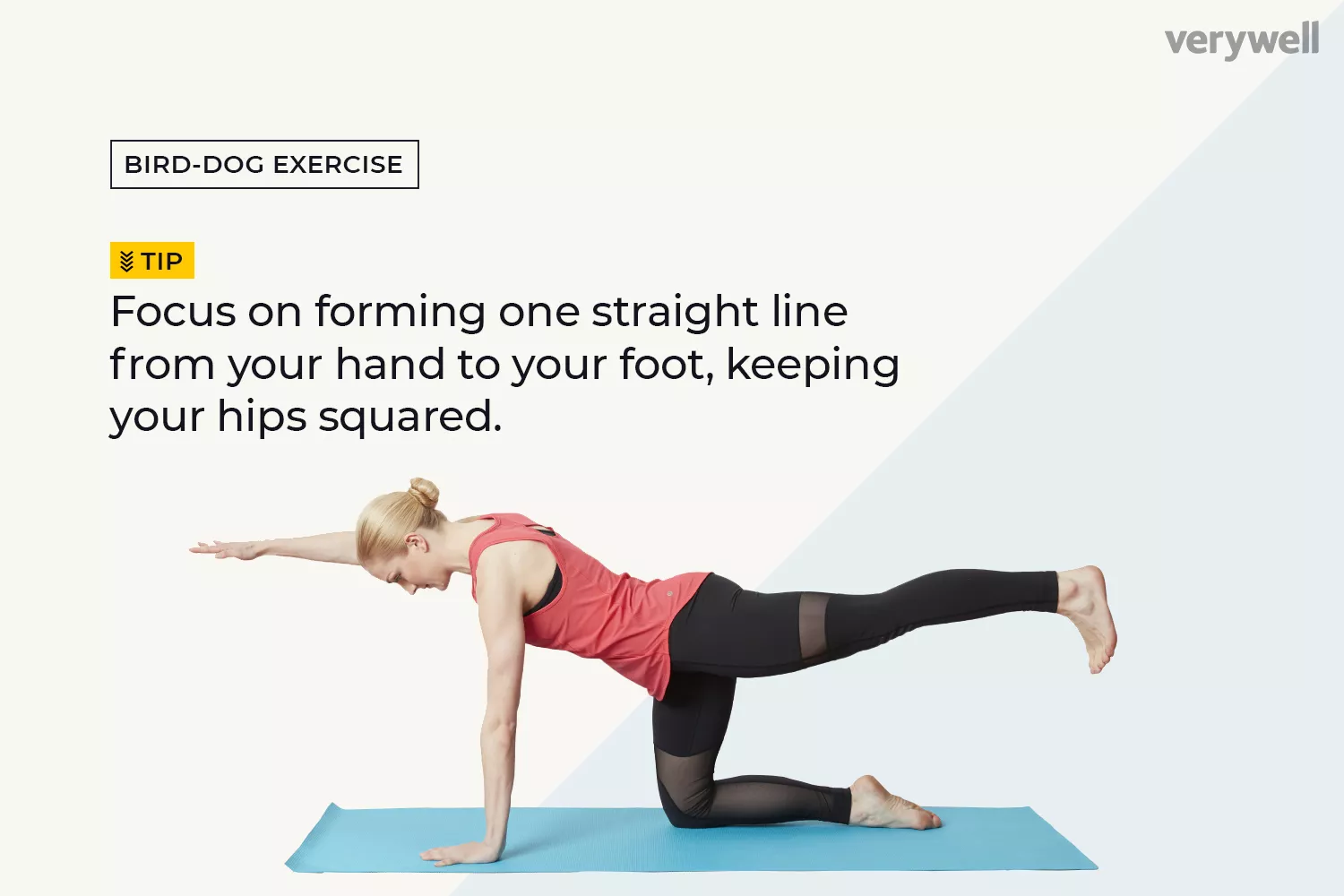
Find a spot with enough space to extend one arm and your opposite leg simultaneously. Kneel on an exercise mat or other cushioned surface with your knees hip-distance apart and hands firmly on the ground, about shoulder-width apart. Engage your abdominals.
- Point one arm out straight in front and extend the opposite leg behind you, forming a straight line from your extended hand to your extended foot. Keep your hips squared to the ground. If your lower back begins to sag, raise your leg only as high as you can while keeping your back straight.
- Hold for a few seconds, then return to your hands and knees. Keep your abs engaged throughout the entire exercise and work to minimize any extra motion in your hips during the weight shift.
- Switch to the other side.
- Aim to complete five reps on each side or 10 reps total. Add additional sets of 10 exercises for a maximum of three sets of 10. As a variation of the bird dog exercise, you can do a set of 10 on one side, then switch to the opposite side.
If you struggle with good form, practice the bird dog exercise first by lifting your hand and opposite knee just an inch or two off the floor while balancing on the other hand and knee and keeping your weight centered. When you feel steady, you are ready to move on to a full range of motion.
Benefits of the Bird Dog Exercise
The main target of the bird dog is the erector spinae muscle. This long back muscle extends the length of the spine from the skull, neck, and ribs to the vertebrae and sacrum of the hip. It is responsible for extending, flexing, and rotating the spine.
Two abdominal muscles are particularly challenged by bird dog exercises: the rectus abdominis and the obliques. This move also involves the gluteus maximus in the buttocks, the trapezius in the upper back, and the deltoids in the shoulder.
Other muscles are involved in stabilizing the bird dog, including:
- The hamstrings on the back of the thigh
- The other gluteal muscles (medius and minimus)
- The piriformis and obturator externus of the hip
- The pectoralis and serratus muscles of the chest
- The triceps of the upper arm
Both athletic trainers and physical therapists use the bird dog exercise with their clients. It is good for building lower back function, as it engages both the core and back at the same time.
The bird dog may reduce lower back pain and is a safe exercise during recovery from a back injury. A strong core and good spinal stability can help in everyday tasks involving bending and twisting.
Other Variations of the Bird Dog Exercise
You can perform the bird dog in different ways based on your fitness level and goals.
No Arm Extension
If you have difficulty with the dual arm-leg movement, begin by extending one leg at a time and not extending the arms. Once you can do this with good form and stability, progress to extending the opposite arm at the same time as the leg.
Zipper
Rather than returning the hand and knee to the ground between each rep, bend your elbow and bring your opposing knee forward until they touch under the body. This mid-exercise touch increases the tension placed on your core as you work to keep your balance.
Bird Dog on a Bench
You can use a weightlifting bench to add a further challenge. Kneel on the bench with your feet hanging free off its end, eliminating your lower leg's contribution to your stability.
Bird Dog on an Exercise Ball
Place an exercise ball under your hips for the bird dog. You won't be able to get your knees on the ground, so you are balancing on the toes of your foot instead, creating even more of a stability challenge.
Bird Dog From Pushup Position
Rather than having your knees on the ground, get into a push-up position and balance on the toes of your feet and hands. This variation is similar to doing bird dogs on the exercise ball but even more challenging.
Single-Side Bird Dog
This is an advanced variation of the bird dog exercise which you should only do if you have mastered the basics. To do it, extend the arm and leg on the same side of the body simultaneously.
Bird Dog Exercise: Common Mistakes
Avoid these mistakes to keep proper form and reduce injury risk.
Chest Sag
Watch your upper body when doing the bird dog exercise or any variations. If your chest sags, your shoulders will be too close to your ears.
Excessive Spinal Curve
It's just as important that your back does not curve excessively during the movement. Aim to keep your torso straight and your spine in a neutral position.
To test your form, place an empty plastic cup on your lower back. If it falls off, continue to work on extending one leg or one arm at a time.
Safety and Precautions
You should not do the bird dog exercise if you have shoulder pain. If you have had a back injury, check with a healthcare professional or physical therapist about when this exercise might be beneficial. Stop doing it if you experience pain in your shoulders, back, or hips.
Try the Bird Dog Exercise
Create your bird dog workout by incorporating this and similar moves into one of these popular workouts:
- Core Strengthening Exercises for Runners
- Exercises for Sciatica
- Glute Activation Exercises
Comments on "Bird Dog Exercise: Proper Form, Variations, and Common Mistakes" :
Leave a Reply
RECOMMENDED NEWS

Walking Music Mixes and Playlists
What music pumps you up while exercising? The walking music you choose may impact the effectiveness...
Shop Now
The 12 Best Walking Shoes for Flat Feet in 2025, Tested
If you have flat feet, wearing supportive shoes can help prevent aches and fatigue after a long da...
Shop Now
How to Do a Reverse Fly: Proper Form, Variations, and Common Mistakes
Also Known As: Dumbbell reverse fly, bent over reverse fly, rear delt fly Targets: Rear shoulders a...
Shop Now
How to Do a Dumbbell Pullover: Proper Form, Variations, and Common Mistakes
Also Known As: Lying pullover, chest pullover, pullover Targets: Chest and back Equipment Needed: W...
Shop Now
What Do Compression Socks Do? Understanding the Benefits and Uses
Compression socks have become increasingly popular in the past 15 years among runners, triathletes,...
Shop Now
The 11 Best Infuser Water Bottles to Keep You Hydrated, According to Experts
Hydration is critical to staying healthy, but often, we aren't drinking enough water to meet our d...
Shop Now